The iPhone Duo is Apple’s first foldable, and the details show it was built with care: a titanium frame, a crease that’s tough to spot, software that changes with the angle of the screen. It also costs $1,999 to start, outweighs every major rival, and has no published durability rating for the hinge or the screen that bends.
A note on sourcing: we haven’t tested this phone. What follows is Apple’s published specs as reported by other outlets, plus early hands-on coverage. Independent reviews are still coming, so treat the battery and durability numbers as claims, not results.
What you get: the hardware
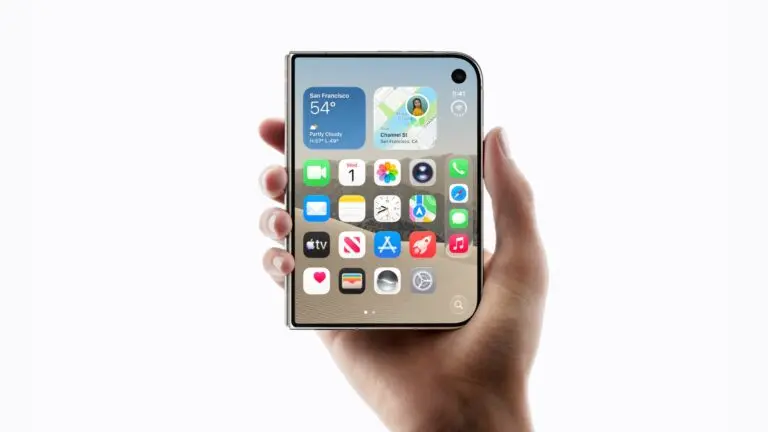
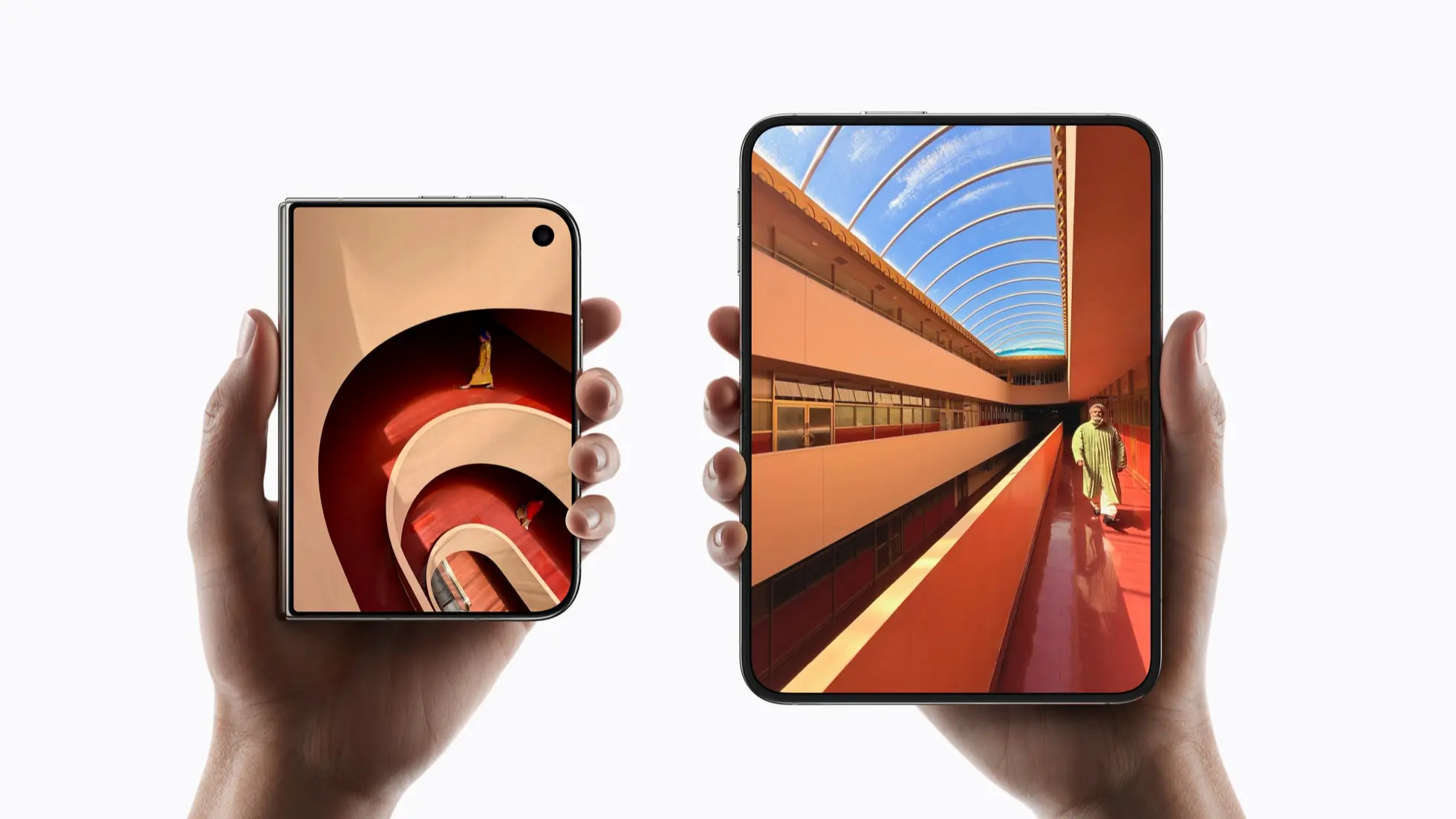
The Duo is a book-style foldable. Closed, you get a 5.4-inch outer display, and open it becomes a 7.6-inch inner one, per Tom’s Guide’s spec rundown. Both are Super Retina XDR panels with ProMotion, an always-on mode and peak brightness up to 3,000 nits. Apple says the two share an aspect ratio, so apps shouldn’t show awkward black bars when you unfold it. The inner screen is 1,878 by 2,670 pixels, and both screens get a matte nano-texture finish and work with Apple Pencil.
The frame is grade 5 titanium with a hinge that blends titanium and aluminum. Ceramic Shield covers the closed front and back, and the phone carries an IP68 rating for dust and water. Open, it measures 5.2 mm thick. Closed, it is 11.3 mm thick and weighs 254 grams.
Inside is the A20 Pro, the same chip as the iPhone 18 Pro, with 12GB of RAM and Apple’s in-house C2 modem. Apple says the C2 is 50% faster and 15% more efficient than the C1X. Unlock is by Touch ID on the side button or with a paired Apple Watch. There is no Face ID.
The crease: Apple’s biggest bet
Every foldable lives or dies on its crease. Apple does not claim to have removed it. TechRepublic reports that the inner display uses layers of high-strength glass, a titanium plate, custom adhesives and a polymer cover layer, all meant to flex together and relieve stress on the screen, while the matte finish scatters reflections that would otherwise outline the fold.

First impressions are good, though reviewers don’t agree on how good. TechRepublic notes that The Verge called the crease nearly invisible in normal use, while MacRumors could still spot it in some lighting but found it harder to feel. Tom’s Guide editor-in-chief Mark Spoonauer called the inner screen “breathtaking” after his hands-on and said you can’t really feel the crease, though you can see it. All of that comes from demo units on day one, not months of daily wear.
Cameras: strong, with one clear gap
Two 48-megapixel cameras sit on the back: a main sensor at f/1.6 and an ultrawide at f/2.2. Video goes up to 4K at 120 frames per second. You also get a Camera Control button, cameras that work in any orientation, and a hidden inner camera for FaceTime when the phone is open.
Zoom is the weak spot. Tom’s Guide’s hands-on found no dedicated telephoto lens, and the 2x mode simply crops the main sensor, which Spoonauer said isn’t the same thing as a true telephoto. The spec rundown is less clear on this, so check Apple’s final listing before you buy if zoom matters to you. Apple did add some tricks aimed at foldables. Duo Preview puts a live view on the outer screen so your subject can see the shot, and Smart Take fires the shutter once it decides everyone is in focus.
Software: where the Duo earns its price
Open an iPhone Duo and the first thing you notice in iOS 27 is the Dock, which now sits on the right edge of both screens. Unfolded, the Home Screen shows two pages with Today View on the left, and two apps can run side by side. The half-open posture is where it gets clever: a video plays on the top half while its controls drop to the bottom half. Safari can open a second window, and a video can stay pinned in portrait.
Spoonauer said this angle-aware behavior is the Duo’s main advantage over Samsung’s Galaxy Z Fold 8. It is also the area with the most open questions: he was unsure how many third-party apps will be optimized by the October 23 release, naming Zoom and Slack as ready.
Battery and charging
Apple claims up to 44 hours of video on the outer display alone, 31 hours on the inner display and about 24 hours when you split time evenly. The battery is 4,883 mAh. These are Apple’s figures, and none has been independently tested.
Charging speed is where the sources disagree. One spec rundown lists 20-watt wired charging, while Tom’s Guide’s hands-on says Apple quotes 50% in 20 minutes on a 60-watt charger. Both cannot be right, so wait for Apple’s final spec sheet. The same goes for wireless charging, which the spec listing does not mention even though Tom’s Guide says the Duo has built-in MagSafe.
Pricing and what it could really cost
The Duo costs $1,999 for 256GB, $2,199 for 512GB, $2,599 for 1TB and $3,199 for 2TB. HotHardware’s comparison lists the Galaxy Z Fold 8 at $1,899.99 normally and $1,649.99 on sale, with the Pixel 11 Pro Fold at $1,899. That puts Apple about $100 above both on list price, and roughly $350 above the discounted Samsung.

The price of an accident is steeper. iThinkDiff reports that an inner display repair without coverage costs $999, an outer display $379, a back glass $199 and a battery service $229, with other damage reaching $1,499. AppleCare+ reportedly costs $19.99 a month, $199.99 a year or $399 upfront, and cuts the inner display repair to $99. That is a secondary report and the fees are estimates, so confirm them with Apple before you order. For a phone with a screen that bends, though, the coverage looks close to mandatory.
The good
The Duo’s best traits are the ones Apple controls end to end: a polished, angle-aware interface, a flagship chip, a durable-sounding build and a crease that early reviewers describe as faint. It also supports Apple Pencil on both screens, a feature 9to5Google notes Samsung dropped with the Fold 7, and it fits into an iPhone, Mac and Watch setup without a learning curve.
The bad
The Duo is heavy and thick. 9to5Google’s comparison puts it at 254 grams and 11.3 mm closed, against 239 g and 10.1 mm for the Pixel 11 Pro Fold, 215 g and 8.9 mm for the Galaxy Z Fold 8 Ultra, and 201 g and 9.7 mm for the Fold 8. The author calls it bulkier than it should be in 2026 and speculates that Pencil support may account for some of the extra bulk. Spoonauer called it “a bit heavier and thicker than I was hoping for.”
Other drawbacks: no telephoto lens, 12GB of RAM against 16GB on the Fold 8, and two-app multitasking where Samsung runs three. It is also a first-generation product. Apple has not published how many folds the hinge or display can take, and delivery dates now stretch into January, as we covered in our report on the pre-order slip.
How it compares
Samsung’s Fold 8 is lighter and cheaper, and it runs three apps at once. Google’s Pixel 11 Pro Fold has the largest inner screen of the three, at 8 inches, along with a long-zoom camera. What the Duo has going for it is the chip, Pencil support, the Apple ecosystem and, if early reports hold up, a crease that hides better. HotHardware calls it the pick for iOS users who will pay a premium. That’s fair.
Who should buy, and who should wait
Think about what you carry now. If it’s an iPhone, a Mac and a Watch, the Duo slots in without friction, and the bigger screen might stand in for a tablet. Budget for AppleCare+ on top of the $1,999 or more. If weight, zoom or price rank higher for you, hold off, and the same goes if you’d like a few months of durability reports first. Early buyers of any new hinge are the ones who learn where it breaks.
Editor’s take
Apple probably shipped about the best first foldable it could, though not the lightest or the cheapest. The crease and the chip won’t decide whether it works out; the hinge will, after a year of daily folding, and nobody outside Apple knows how that goes yet. Waiting costs you little, and if you can’t wait, buy the coverage with the phone.